If you’re reading this while trying to plan your entire life and figure out who you are, it helps to better understand why you feel stuck and what to do about it.
The weight you feel, and the pressure you experience, are real. Time keeps moving forward, and sometimes, it can feel like you’re falling behind while everyone else seems to have life figured out. You’re not alone.
Mental Traps
Have you ever put your two index fingers into a Chinese finger trap? It’s a small, woven tube just big enough for a finger at each end. Once you put your fingers into the trap, the harder you try to pull them out, the harder the tube clamps down. The only way out of a finger trap is to push further in, before slowly sliding your fingers free.
I keep several Chinese finger traps in my office so people can experience how trying harder sometimes makes things worse.
When we get trapped wrestling with our thoughts, we focus only on the issue we’re trying to solve. But often, we’re missing the deeper issue. We might be planning our careers, trying to fix a difficult relationship, managing anxiety, or figuring out who we are. What we are thinking about is not the problem (i.e., the next job)—the real problem is our relationship with our thoughts and emotions.
The Illusion of Control
Here’s a simple experiment you can try (or imagine).
Find some string and attach something heavy to the bottom. Now, hold it out at arm’s length. Tell yourself to keep your arm and hand very steady. Whatever you do, make sure you don’t let the weight swing left or right.
The weight-on-a-string experiment is excellent at illustrating how our attempts to control our thoughts ultimately lead to a lack of control. As soon as you start telling yourself, “I better not let this string move,” your brain will focus on that thought, and your muscles will start moving your body so that the string moves left and right. What you don’t want is what you get—a key principle of how the mind works.
Again, the real struggle usually isn’t the thoughts themselves, but how seriously we take them. When we treat all of our thoughts and emotions as true and valid, we can get into trouble. We begin to view our experiences and what we feel about things as important reflections of what is real and what we should or should not do.
For example, if you have an angry, aggressive thought, you might conclude you are violent and dangerous—a bad person. When we get hooked by thoughts and emotions, we get dragged into a thick fog of mental confusion that is hard to escape.
The truth is, we don’t have much control over what goes through our minds. We can direct our thinking to some degree, but many thoughts show up uninvited. Recognizing that our minds are noisy can release us from unnecessary struggle.
The Struggle
Scripture reminds us that what fills our minds matters (Philippians 4:8) and that God is transforming us through the renewal of our minds (Romans 12:2). What occupies our minds shapes what we believe. Yet we can still find ourselves stuck, questioning God’s love, wondering whether we’ve “missed” his perfect will, or whether we have a place in his family.
It’s easy to get hooked by one of the many “what if…” thoughts and go down the proverbial rabbit hole. When I struggle with my unhelpful mind, which I often do, I find it helpful to stand outside of what is happening in my head and notice it. I imagine my thoughts and emotions projected onto a private movie screen. I watch them unfold, but from a distance.
When dealing with our thoughts, we have two choices: we can look through them, or we can look at them. When we look at life through our thoughts, they can distort our experience. If you say to yourself, “I’m such a loser”, that thought will filter what you see. If a friend doesn’t quickly reply to your message, you say, “See, that’s proof I am a loser.” But when we look at our thoughts, we notice them, evaluate them, and see them for what they are: just thoughts.
Finding Your Way Out of the Fog
If your mind has been spinning lately, you aren’t broken. You’re just human! Sometimes, our minds will wander, worry, and imagine the worst. But the first step out of the fog doesn’t require a solution for each question. Instead, it’s learning to acknowledge the thoughts passing through your mind without letting them take control.
Want to Go Deeper?
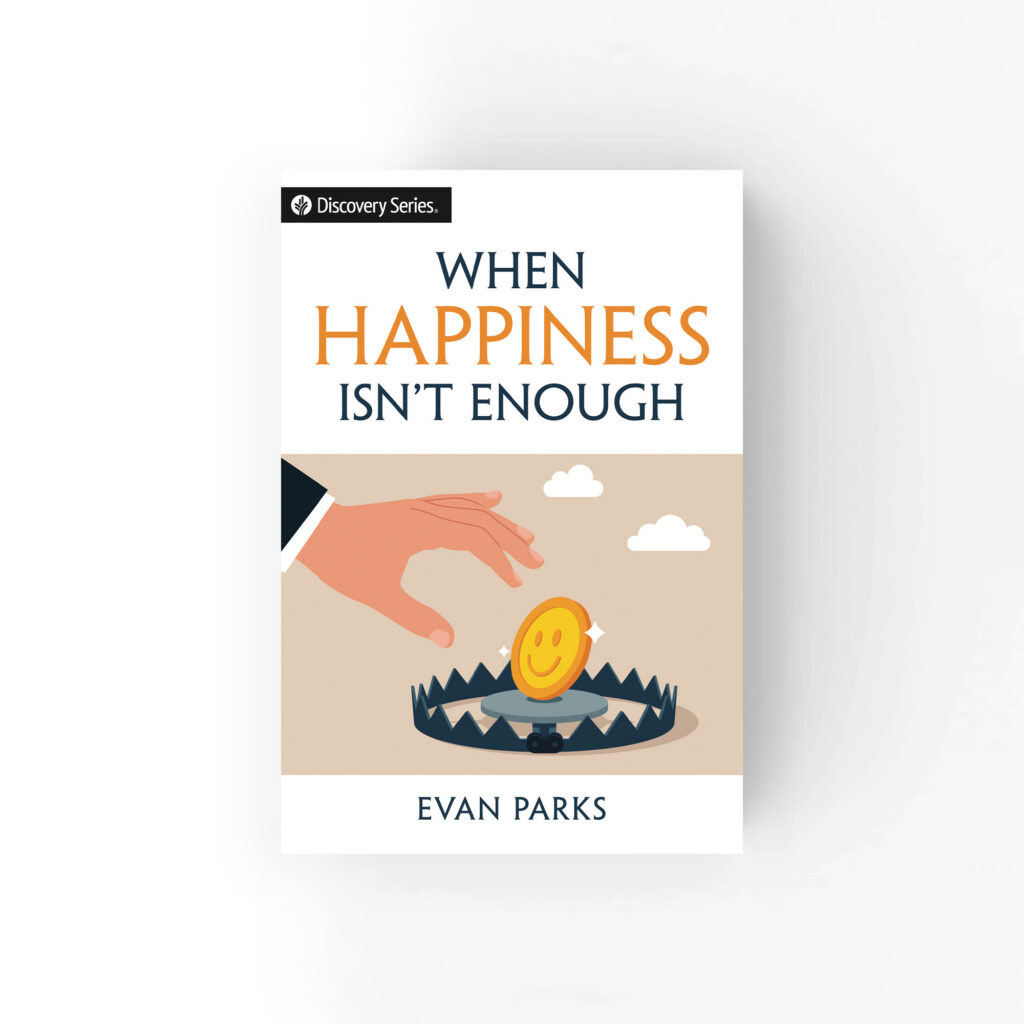
If this experience sounds familiar, the Discovery Series resource When Happiness Isn’t Enough explores these ideas through the story of Hudson, a college student who feels stuck despite outward success. His journey shows how the pressure to stay happy and in control can actually trap us, and that learning to relate to our thoughts differently can bring clarity and freedom. You might find that parts of Hudson’s story feel surprisingly close to your own.
Discovery Series is a part of our parent ministry, Our Daily Bread Ministries. We’re always delighted to have the opportunity to share their hard work!
To download the free booklet, go here!
**Note: Though the author is an expert in his field, we here at Reclaim Today are not mental health professionals. If this is a struggle you have, or if life just feels a bit out of control, consider seeking the help of a therapist or medical professional, or calling the Suicide Prevention Line at 988.